Compounding Slope Criteria Across Closely Spaced Intervals
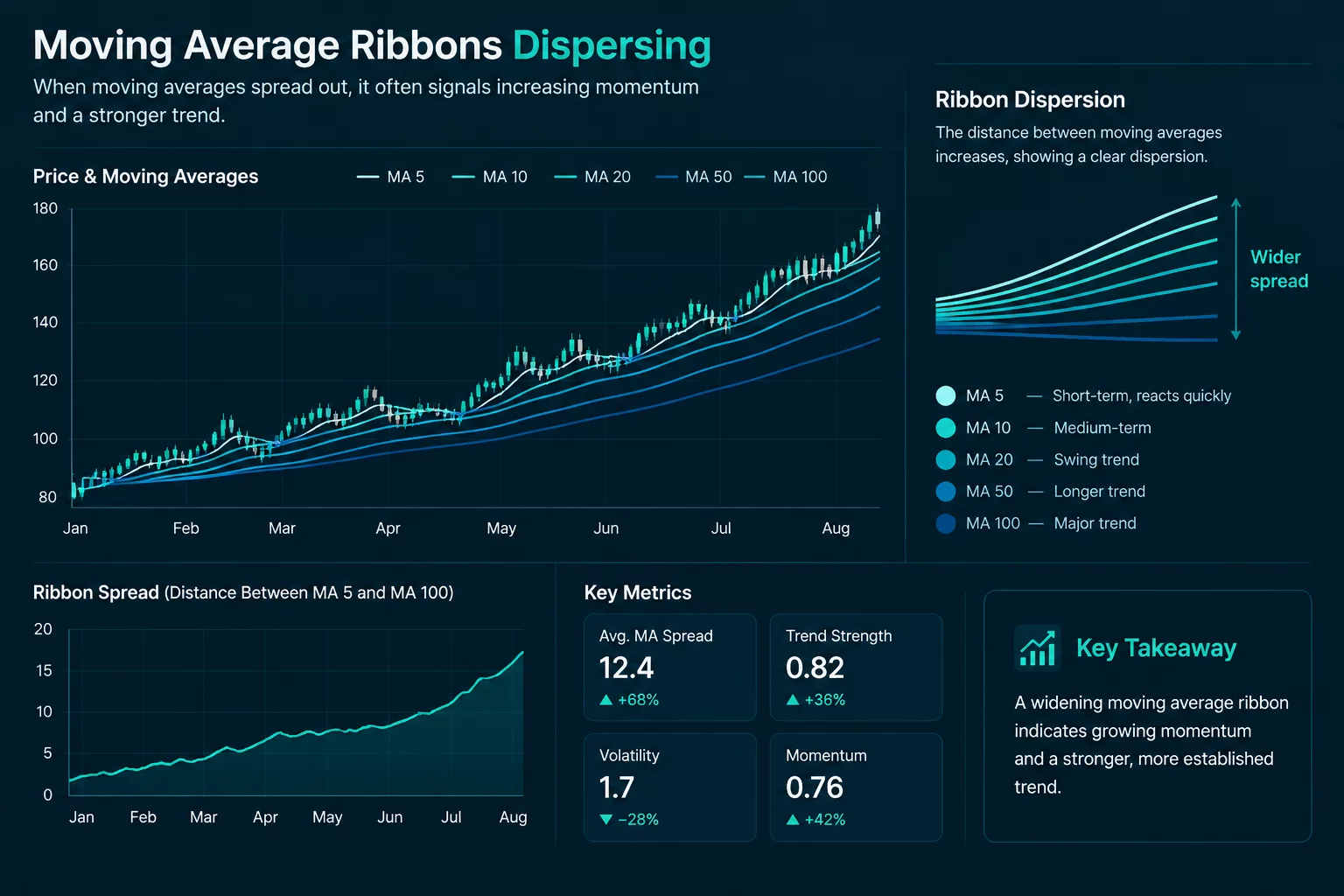
Quantitative designers frequently fall into the trap of combining identical mathematical derivatives computed over slightly altered intervals. In trend-following EasyScan setups, this manifests as requiring the 20-period simple moving average slope to be strictly positive while simultaneously mandating that the 21-period exponential average or 30-period linear regression slope also exceed an arbitrary hurdle rate. The premise seems prudent on paper: require multiple confirming trend trajectories to verify momentum.
In empirical practice, these conditions sample the exact same underlying price distribution with infinitesimal phase shift. The Pearson correlation between the slope of a 20-day SMA and a 21-day EMA routinely surpasses 0.97 across broad equity universes. Instead of isolating two distinct behavioral properties of an equity, the screener executes redundant arithmetic that consumes computing overhead, obscures condition sensitivity, and misleads the researcher into believing the pipeline possesses multi-layered verification.
Collinear Mechanics & Redundant Filter Overlap
When two filters exhibit near-perfect collinearity, their intersection set almost completely mirrors their individual subsets. Evaluating candidate attrition across a 4,800-stock universe clarifies this duplication:
- A primary condition requiring SMA(20) 5-day slope > 0 admits 1,648 securities from the universe.
- Appending an additional clause demanding EMA(21) slope > 0 eliminates merely 18 tickers, indicating a 98.9% outcome duplication.
- The few eliminated securities represent boundary noise and micro-whipsaws rather than meaningful structural divergences.
Constructing an Explainable Linear Trend Baseline
A robust screening condition stack relies on orthogonal dimensions: trend direction, liquidity thresholds, and consolidation compression. Substituting multiple collinear slopes with a single, well-calibrated rate-of-change or linear regression slope on the 50-day trajectory restores interpretability. If trend duration is genuinely being targeted, pair a mid-horizon slope with price relation to a long-horizon anchor rather than compounding nearby slope formulas.
Rule of Orthogonality in Trend Conditions
Every added condition must target an independent market dimension. If removing a second trend filter alters the final qualifying cohort by less than 5%, the condition is mathematically redundant and should be purged from the EasyScan pipeline.