Fundamental Stability and Price Consolidation Stack
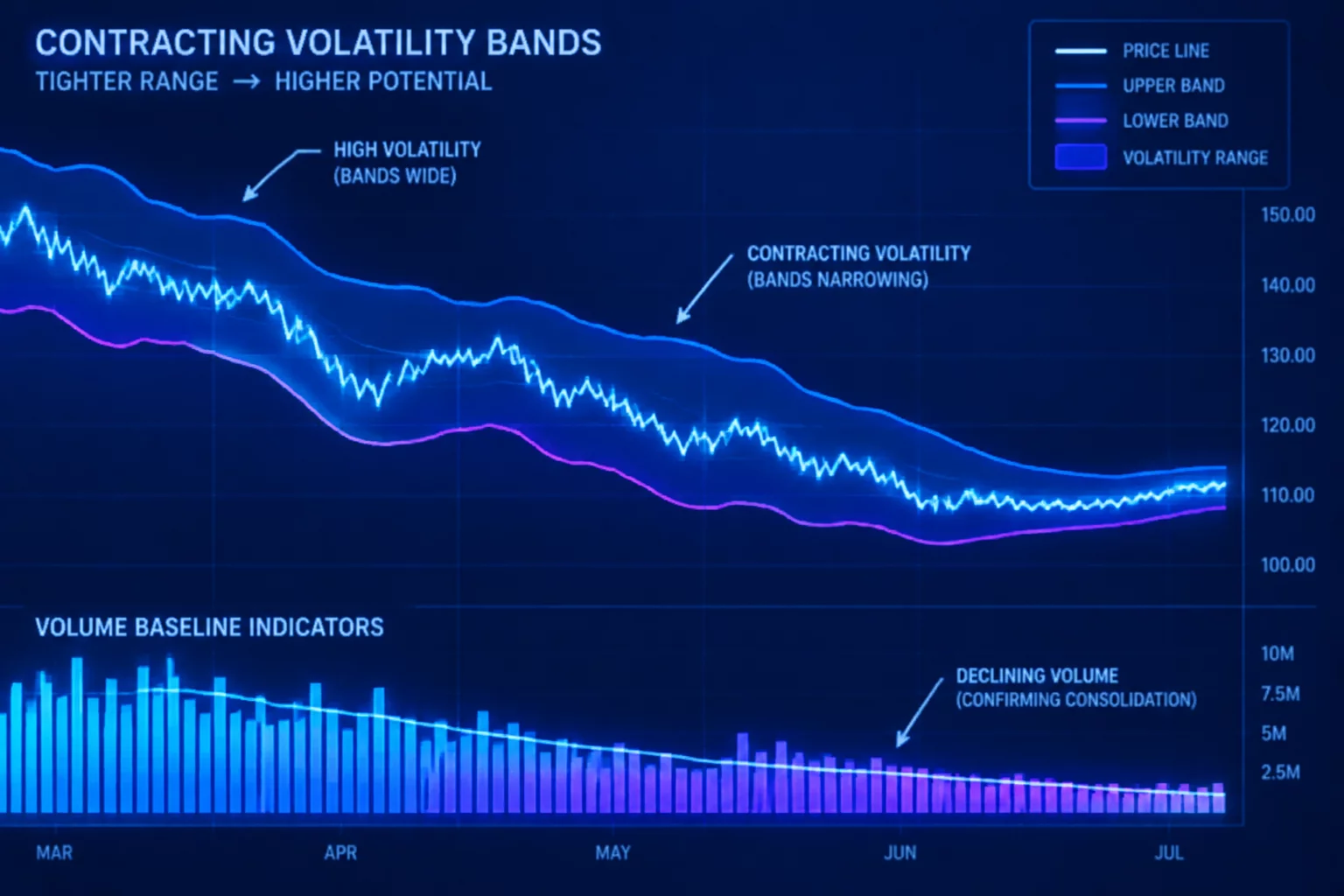
Pairing balance sheet solvency filters with tight price base compression to surface fundamentally sound consolidation patterns.
A systematic three-stage filtering pipeline designed to compare liquidity, trend, and relative-volume criteria and explain which observations each condition excludes.
Screener construction fails most frequently when analysts impose complex momentum formulas onto an unfiltered stock universe. Calculating moving average relationships or price channels on thinly traded securities generates endless noise, false signals, and erratic outliers. In this multi-factor stack, the pipeline establishes a strict turnover threshold of fifteen million dollars daily dollar-volume before evaluating price behavior.
By establishing a robust liquidity boundary in step one, computational resources remain focused solely on liquid equities where technical formations reflect broad institutional participation. The subsequent trend filters assess exponential slope stability across multiple daily periods, ensuring that minor intraday spikes do not distort the underlying multi-week trajectory.

Explore the syntax mechanics and personal condition formula configurations required to deploy this three-stage pipeline without triggering platform execution lag.
When testing multiple factors simultaneously, boolean intersections can inadvertently discard prime candidates if condition criteria overlap or contradict one another. A common error involves pairing an excessively tight moving average envelope with an extreme relative volume multiplier, which shrinks output to zero during healthy market consolidations.
This stack addresses potential over-filtering by separating trend qualification from volume expansion. The trend filter checks structural alignment across medium and long horizons, while the volume requirement acts as a momentary catalyst validator rather than a permanent barrier. The resulting watchlist delivers clear, explainable setups suitable for manual review.
A screening stack should behave like a precision lens rather than a blunt sieve. If you demand perfection on every single metric simultaneously, you filter out the strongest real-world trends before they even develop.
Place high-attrition liquidity checks at the very start of the stack to strip away noisy outliers before running intensive multi-period indicator calculations.
Keep multi-week moving average slope definitions broad enough to accommodate pullbacks, comparing how tighter multipliers change the remaining candidate set.
If broad market consolidations reduce passing candidates to zero, examine whether volume hurdles or range contractions are creating collinear bottlenecks.
Tell us which condition or sequence you are investigating. Share a question, a correction, or a point that needs a clearer explanation.
Multi-Factor Trend and Volume Baseline
Our editorial desk discusses educational screening logic. It does not provide securities recommendations or trade signals.