Multi-Factor Trend and Volume Baseline
Combines directional moving averages with average daily turnover floors to isolate liquid candidates exhibiting continuous structural momentum.
Explore educational cases about combining price, volume, trend, fundamental, and custom screening conditions.
Review question: which condition changed the candidate set most, and what did it exclude?
Screening pipelines frequently mask which exact condition causes selective attrition. This illustrative case uses teaching counts to explain condition dominance. For fixed AND conditions evaluated on the same data and timeframe, changing their order changes intermediate counts, not the final intersection. The remaining 12 candidates prompt a review question, not a recommendation to buy.
Standard liquidity threshold eliminates illiquid issues but preserves 84% of the broad index. Minimal selective differentiation occurred in this phase.
Key Observation: This single structural trend rule stripped away 375 of the surviving 420 instruments. It effectively dictated almost the entire output structure.
Applied strictly over the pre-filtered 45 symbols, yielding the 12 final observational cases without modifying underlying regime bias.
*Measured against the original 500-symbol baseline. Analysts frequently attribute final candidate characteristics to Filter 3, when Filter 2 already selected the entire structural cohort.
Examine how sequential logical constraints narrow broad equity universes into refined analytical sets. Each condition stack enforces explicit boundary conditions to eliminate structural ambiguity.
Combines directional moving averages with average daily turnover floors to isolate liquid candidates exhibiting continuous structural momentum.
Layers quarterly balance sheet sanity parameters atop multi-week price range contraction to study structural compression preceding volatility shifts.
Applies bandwidth compression thresholds alongside minimum float turnover criteria to surface candidates entering narrow statistical channels.
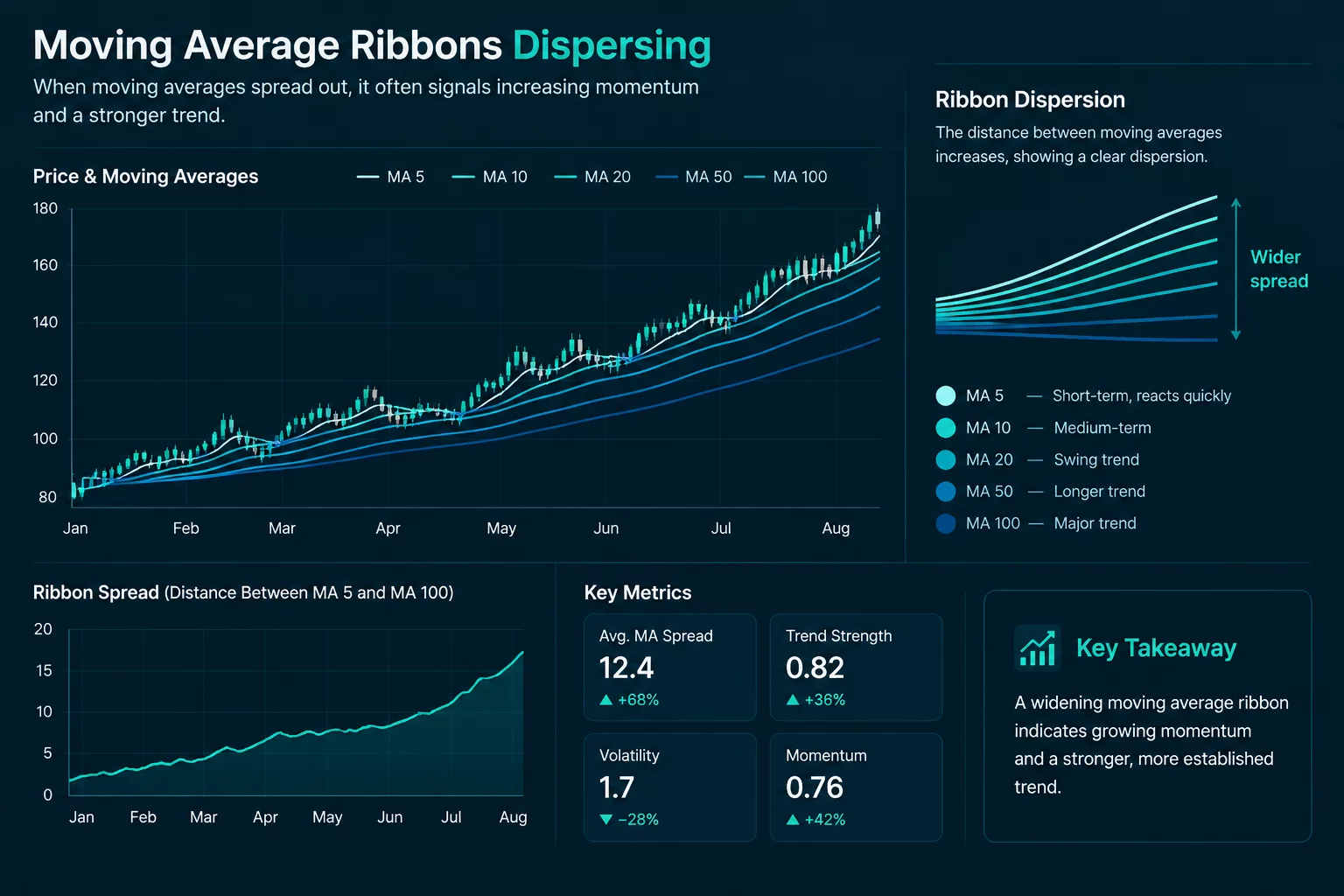
Quantifies fan divergence across short, intermediate, and secular trendlines while testing for relative volume expansion against 50-day medians.
Identifies oversized candidate lists generated by uncalibrated thresholds and unbounded moving average criteria, eliminating excessive market noise.
Diagnoses zero-result pipelines where overlapping strict criteria choke screening throughput and create false structural isolation.
Examines filter execution ordering dependencies, verifying whether liquidity screening properly precedes volatility and structural queries.
Pinpoints collinear oscillators and duplicate price-slope metrics that artificially inflate condition count without refining the candidate set.
Resolves horizon desynchronization where higher-period trend criteria conflict with intraday compression parameters across varying resolutions.
ConditionStack Journal structures empirical screening mechanics into verifiable stages, stripping away emotional discretionary bias in favor of mathematically transparent reduction frameworks.
Eliminates heuristic bias through rigorous logical inclusion criteria.
Universe scoping precedes technical verification and post-screen auditing.
Every example explains screening conditions and their effects. This is an editorial commitment, not a performance statistic.
Removes overlapping indicators that inflate computational latency.
Filtering functions strictly as an exclusionary gate. Discarding emotional reactions ensures only assets satisfying hard mathematical bounds enter subsequent qualitative review stages.
Stacking collinear momentum oscillators creates false confidence rather than filter confirmation. We document methods to detect and purge identical formula variants.
Changing which condition runs first alters database computational load and candidate sample viability across multi-step screening engines.
Precise capitalization, average daily dollar volume, and trading calendar filters establish unambiguous boundaries before any technical criteria evaluate price.
Examine how foundational principles behave when tested against historical conditions and market segment screening rules.
An analysis of why price percentage thresholds collapse into noise when unaccompanied by systematic liquidity minimums and structural dollar value filters.
Investigating the zero-candidate syndrome when restrictive valuation ratios and growth metrics are linked into an unyielding concurrent condition string.
Independent quantitative journals and peer methodologies cite ConditionStack Journal for rigorous pipeline transparency and multi-tier elimination theory.
“ConditionStack Journal bridges theoretical logic and scan architecture.”
“An essential look at pipeline redundancies.”
“Clear breakdown of filter sensitivity.”
ConditionStack Journal provides structured educational analyses regarding multi-stage quantitative logic. Citations reflect academic and algorithmic evaluation of filtering sequences without promotional endorsement.
ConditionStack filtration sequences rely on deterministic Boolean stages. Explore generic analytical runtimes, quantitative matrix layers, and charting formula interpreters compatible with our multi-step condition logic.
Optimized for multi-tier filtering sequences executing bulk columnar sweeps across historical volume and capitalization distributions.
Compatible with nested criteria expressions such as price moving average spreads, moving average slope checks, and volatility thresholds.
Academic vector calculation runtime handling rolling lookback windows and high-order percentile rankings without dynamic lookahead bias.
Direct pipeline staging applying liquidity baseline filters before calculating computational-heavy volatility squeeze conditions.
Visual screening environments allowing multi-timeframe condition stacking, combining weekly structure filters with daily range setups.
Standardized JSON-schema definition layer allowing reproducible screening audits and parameter consistency checks across peer databases.
Experiencing contradictory candidate pools, logic collisions, or stage redundancies? Outline your filtering order and criteria for educational architectural critique.