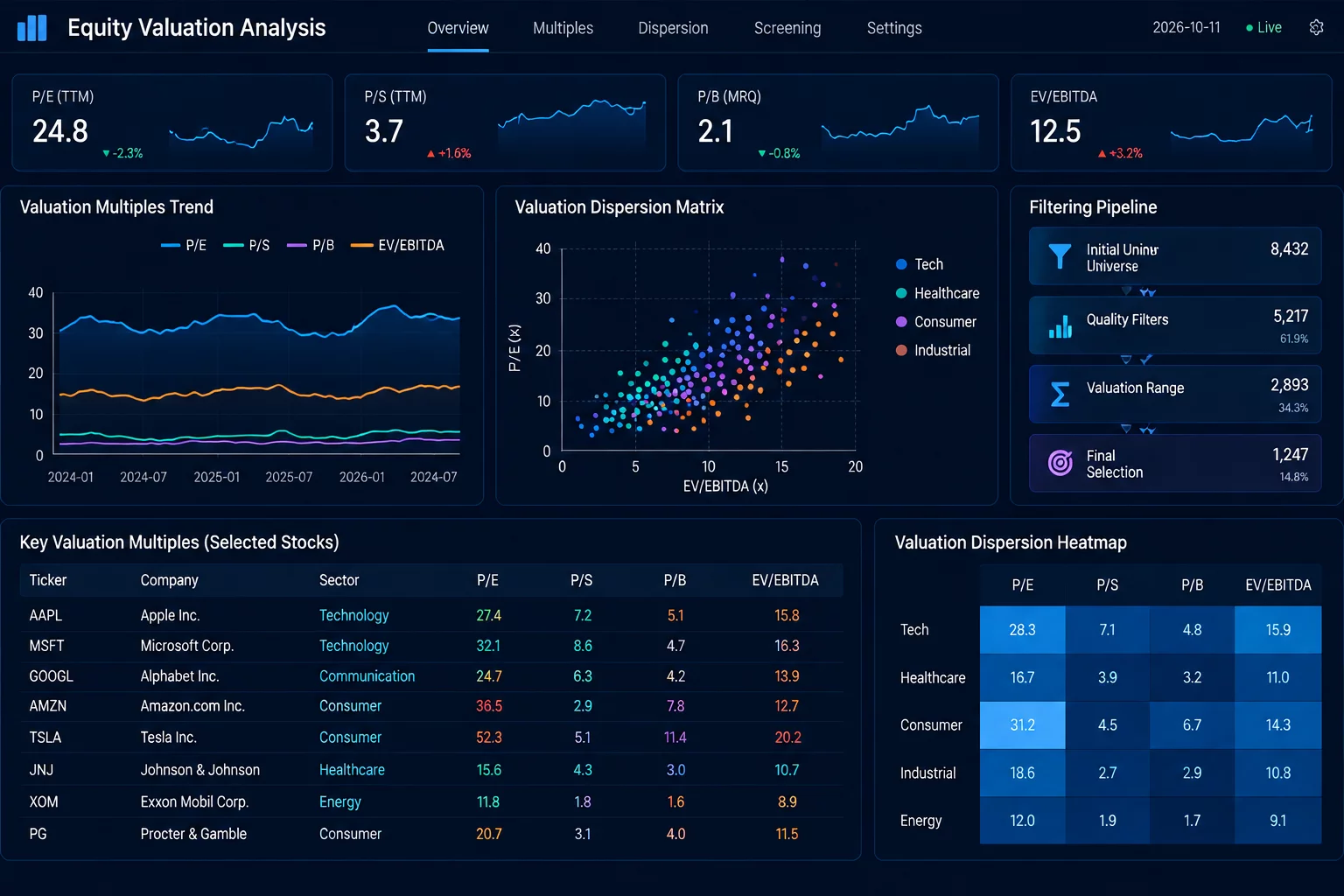
The Anatomy of Multi-Valuation Over-Constrained Pipelines
Screen architects frequently attempt to synthesize the ultimate value and growth screen by requiring low Trailing P/E, depressed PEG ratios, sub-1.5 Price-to-Sales, and attractive EV/EBITDA simultaneously. While the intuitive thesis sounds prudent—attempting to safeguard against paying up for any single metric—the underlying quantitative reality is that distinct multiples measure fundamentally discordant dimensions of enterprise economics. Each multiple carries unique accounting assumptions, debt sensitivities, and industry baselines.
When three or four rigid numeric thresholds are applied concurrently across an unsegmented equity universe, the filters do not create a safe consensus. Instead, they act as an aggressive sieve that punishes normal capital structures. Software companies with negative trailing earnings but exceptional top-line expansion vanish on P/E. Asset-heavy utilities pass EV/EBITDA but fail PEG requirements. Meanwhile, capital-efficient compounders with premium multiples are instantly wiped out, leaving an empty results table or a handful of distressed value traps.
Structural Incompatibilities Across Common Ratio Combinations
Examining the simultaneous application of classical valuation multiples reveals predictable friction points where mathematical definitions collide:
- Price-to-Sales vs. Net Margin: Demanding P/S under 1.5 alongside P/E under 15 automatically eliminates high-margin SaaS and medical technology while favoring thin-margin retail with fragile earnings.
- PEG vs. Cyclical Peak Earnings: A low PEG ratio during peak cyclical earnings appears attractive, but as earnings normalize, the trailing multiple violently decompresses, exposing trailing screen vulnerability.
- EV/EBITDA vs. High Leverage: Enterprise value penalizes net debt, whereas raw equity multiples like P/E ignore capital structure, creating direct sorting conflicts across leveraged firms.
Architectural Remediation: Rank-Sum and Sector Normalization
Instead of stacking hard absolute numeric walls such as P/E below 15 alongside P/S below 2 and PEG under 1, quantitative screening requires modularization. Effective condition stacks isolate a single primary valuation metric appropriate for the target sector, or replace hard hurdles with sector-relative percentile rankings. Scoring candidates by composite rank sums or utilizing stage-gated conditional routing preserves broad candidate distribution without sacrificing fundamental quality.